Reference for Identity
This guide lists the predefined objects in Resource Analytics for Oracle Identity. You can find information about views, entity relationships, subject areas, and sample queries.
Views
This section provides information about views within Resource Analytics Identity and their columns, data types, keys, and the referred view and column names. The following views are available:
| Name | Description |
|---|---|
| TENANCY_DIM_V | This view stores information about the root compartment that contains all your organization's compartments and other Oracle Cloud Infrastructure cloud resources. Note that only tenancies or compartments that are enrolled on this Resource Analytics instance are present here. |
| COMPARTMENT_DIM_V | This view stores information about compartments, the main organizational structure in the Oracle Cloud. Each compartment contains collections of cloud resources, and can also contain other compartments. Your tenancy is also the root compartment. |
| COMPARTMENT_HIERARCHY_V | Denormalized view that stores information on the hierarchical organization of your compartments. |
| IDENTITY_AUTH_TOKEN_DIM_V | This view stores information about an Oracle-generated authentication token string for integrating with third-party APIs that don't support signature-based authentication. |
| IDENTITY_CUSTOMER_SECRET_KEY_SUMMARY_DIM_V | This view stores information about a CustomerSecretKey, which is an Oracle-provided key used to access the Amazon S3 compatible API for the Object Storage service. |
| IDENTITY_DOMAIN_DIM_V | This view stores information about properties for an identity domain, which is used to manage users and groups, integration standards, external identities, and secure application integration through Oracle Single Sign-On (SSO) configuration. |
| IDENTITY_DYNAMIC_GROUP_DIM_V | This view stores information about a dynamic group, which defines a matching rule for certificates on instances, enabling runtime membership and access based on policies for dynamic groups. |
| IDENTITY_GROUP_DIM_V | This view stores information about a collection of users who need the same type of access to a set of resources or compartments within IAM. Groups are mapped to identity provider groups if federating. |
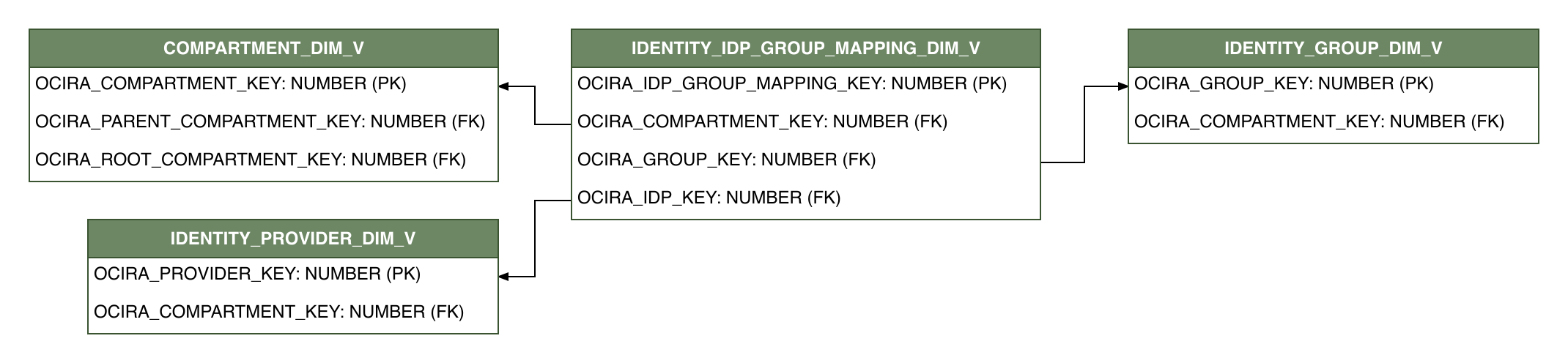
| IDENTITY_IDP_GROUP_MAPPING_DIM_V | This view stores information about a mapping between a single group defined by the identity provider (IdP) and a single IAM service group in OCI. |
| IDENTITY_MFA_TOTP_DEVICE_DIM_V | This view stores information about a registered mobile device for multi-factor authentication (MFA) using time-based one-time passwords (TOTP) for user sign-in. |
| IDENTITY_NETWORK_SOURCES_DIM_V | This view stores information about a network source, which specifies a list of source IP addresses that are allowed to make authorization requests and is used to restrict access in policy statements. |
| IDENTITY_POLICY_DIM_V | This view stores information about a document that specifies the type of access a group has to the resources in a compartment in OCI. |
| IDENTITY_PROVIDER_DIM_V | This view stores information about the resulting base object when you add an identity provider to your tenancy. Supports subtypes such as Saml2IdentityProvider for SAML 2.0 federation. |
| IDENTITY_PROVIDER_GROUP_SUMMARY_DIM_V | This view stores information about a group created in an identity provider that can be mapped to a group in OCI. |
| IDENTITY_SMTP_CREDENTIAL_DIM_V | This view stores information about Simple Mail Transfer Protocol (SMTP) credentials needed to send email through Email Delivery. SMTP credentials are used for SMTP authentication and are Oracle-generated. |
| IDENTITY_TAG_DEFAULT_DIM_V | This view stores information about tag defaults that let you specify a default tag to apply to all resource types in a specified compartment. Tag defaults are inherited by child compartments. |
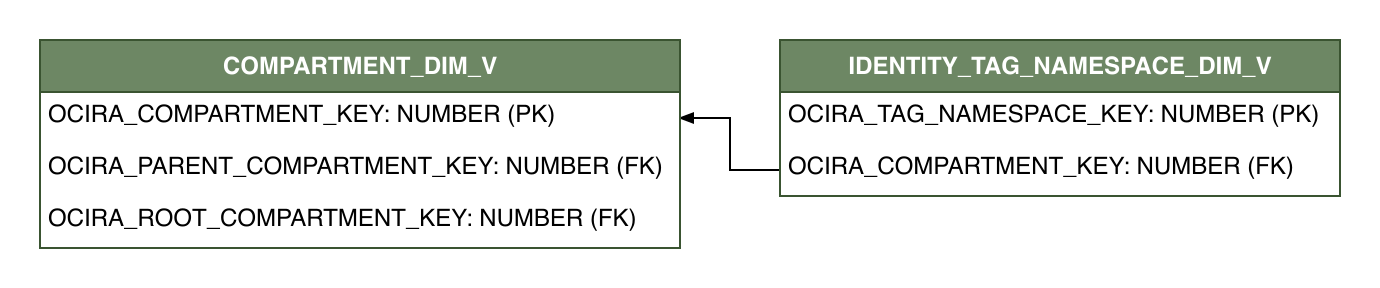
| IDENTITY_TAG_NAMESPACE_DIM_V | This view stores information about a managed container for defined tags. A tag namespace is unique in a tenancy and used to organize and scope tag keys. |
| IDENTITY_USER_DIM_V | This view stores information about an individual employee or system created within OCI that manages or uses cloud resources, with IAM credentials and roles. |
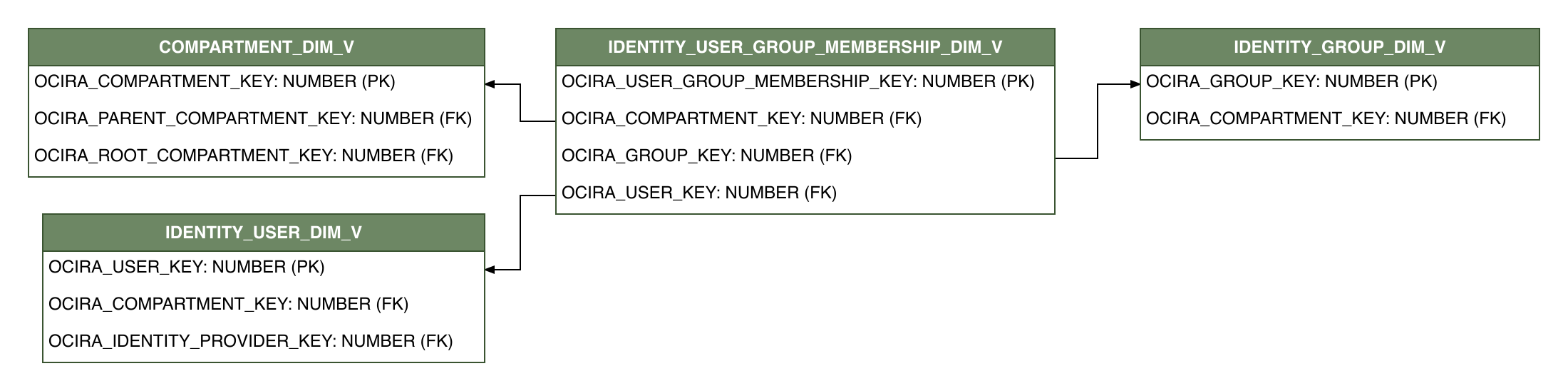
| IDENTITY_USER_GROUP_MEMBERSHIP_DIM_V | This view stores information about the membership of a user in a group. Adding a user to a group creates this object; removing the user deletes it. |
| IDENTITY_DOMAIN_FACT_V | Fact table for OCI Identity domains at domain grain. |
| IDENTITY_DYNAMIC_GROUP_FACT_V | Fact table for OCI Identity dynamic groups at dynamic group grain. |
| IDENTITY_GROUP_FACT_V | Fact table for OCI Identity groups at group grain. |
| IDENTITY_NETWORK_SOURCES_FACT_V | Fact table for OCI Identity network sources at network source grain. |
| IDENTITY_POLICY_FACT_V | Fact table for OCI Identity policies at policy grain. |
| IDENTITY_PROVIDER_FACT_V | Fact table for OCI Identity providers at identity provider grain. |
| IDENTITY_USER_FACT_V | Fact table for OCI Identity users at user grain. |
The suffixes in the view names specify the view type:
- FACT_V: Fact
- DIM_V: Dimension
- HIERARCHY_V: Denormalized hierarchy view
Relationship Diagram
This section provides diagrams that define the logical relationship of different dimension views.
The contents of each view and their relationships are listed in the following file: identity views.
Relationships exist among dimensions. Dimensions can be joined directly to each other. This diagram shows the relationship between dimension views.

These diagrams show the relationship of the fact view with different dimension views.






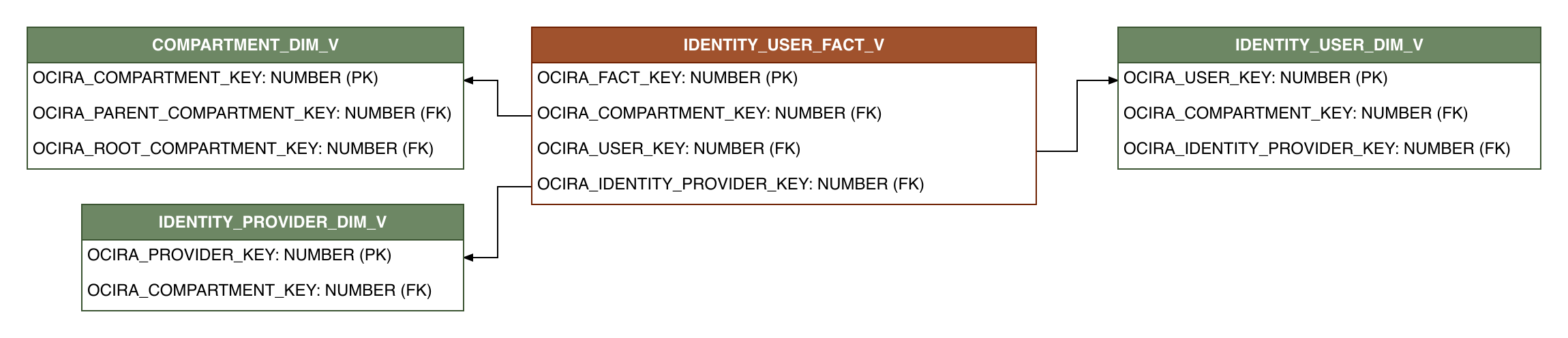
Relationships exist among dimensions. Dimensions can be joined directly to each other. These diagrams show the relationship between dimension views.






Sample Queries
Sample queries for Identity.
SELECT C.ID AS COMPARTMENT_ID, C.NAME AS COMPARTMENT_NAME, T.ID AS TENANCY_ID, T.NAME AS TENANCY_NAME,
 T.DESCRIPTION AS TENANCY_DESCRIPTION, T.TIME_CREATED AS TENANCY_TIME_CREATED
FROM OCIRA.COMPARTMENT_DIM_V C
LEFT JOIN OCIRA.TENANCY_DIM_V T
ON C.OCIRA_ROOT_COMPARTMENT_KEY = T.OCIRA_TENANCY_KEY;SELECT ID, LVL1_COMPARTMENT_ID, LVL1_COMPARTMENT_NAME
FROM OCIRA.COMPARTMENT_HIERARCHY_V;SELECT DOMAIN_ID, DISPLAY_NAME, LIFECYCLE_STATE
FROM OCIRA.IDENTITY_DOMAIN_FACT_V F
WHERE LIFECYCLE_STATE = 'ACTIVE';SELECT DYNAMIC_GROUP_ID, NAME, LIFECYCLE_STATE
FROM OCIRA.IDENTITY_DYNAMIC_GROUP_FACT_V F
WHERE LIFECYCLE_STATE = 'ACTIVE';SELECT GROUP_ID, NAME, USER_COUNT, LIFECYCLE_STATE
FROM OCIRA.IDENTITY_GROUP_FACT_V F
WHERE LIFECYCLE_STATE = 'ACTIVE';SELECT NETWORK_SOURCE_ID, NAME, LIFECYCLE_STATE
FROM OCIRA.IDENTITY_NETWORK_SOURCES_FACT_V F
WHERE LIFECYCLE_STATE = 'ACTIVE';SELECT POLICY_ID, NAME, LIFECYCLE_STATE
FROM OCIRA.IDENTITY_POLICY_FACT_V F
WHERE LIFECYCLE_STATE = 'ACTIVE';SELECT PROVIDER_ID, NAME, MAPPED_GROUP_COUNT, LIFECYCLE_STATE
FROM OCIRA.IDENTITY_PROVIDER_FACT_V F
WHERE LIFECYCLE_STATE = 'ACTIVE';SELECT IDENTITY_PROVIDER_ID, COUNT(USER_ID) AS USER_COUNT
FROM OCIRA.IDENTITY_USER_FACT_V F
GROUP BY IDENTITY_PROVIDER_ID;Data Lineage
The Customer Experience Semantic Model Lineage spreadsheet and Metric Calculation Logic spreadsheet for Identity provide an end-to-end data lineage summary report for physical and logical relationships in your data.
For more information, see Data Lineage.
Subject Areas
This section provides information on the subject areas with data you maintain in Identity. These subject areas, with their corresponding data, are available for you to use when creating and editing analyses and reports. The information for each subject area includes:
-
Description of the subject area.
-
Business questions that can be answered by data in the subject area, with a link to more detailed information about each business question.
-
Job-specific groups and duty roles that can be used to secure access to the subject area, with a link to more detailed information about each job role and duty role.
-
Primary navigation to the work area that's represented by the subject area.
-
Time reporting considerations in using the subject area, such as whether the subject area reports historical data or only the current data. Historical reporting refers to reporting on historical transactional data in a subject area. With a few exceptions, all dimensional data are current as of the primary transaction dates or system date.
-
The lowest grain of transactional data in a subject area. The lowest transactional data grain decides how data are joined in a report.
-
Special considerations, tips, and things to look out for in using the subject area to create analyses and reports.
Other References
- IAM with Identity domains documentation
- IAM without Identity domains documentation
- Tenancy Reference
- Compartment Reference
- AuthToken Reference
- CustomerSecretKeySummary Reference
- Domain Reference
- DynamicGroup Reference
- Group Reference
- IdentityProvider Reference
- IdentityProviderGroupSummary Reference
- IdpGroupMapping Reference
- MfaTotpDevice Reference
- NetworkSources Reference
- Policy Reference
- SmtpCredential Reference
- TagDefault Reference
- TagNamespace Reference
- User Reference
- UserGroupMembership Reference